Showing posts with label Latino-Americans. Show all posts

Sunday, October 10, 2010

Poets and Community: Thoughts from the Latino Books and Family Festival


This past weekend was the Latino Books and Family Festival at Cal State L.A. I was lucky enough to be invited to speak on a panel at the event entitled "From Inspiration to Publication: The Business of Poetry" with poets Alicia Partnoy, William Archila, Rafael Alvarado, Erika Ayon and Melinda Palacio. I was honored to be sitting next to such accomplished writers.

In March I attended a panel at UCLA featuring Alicia Partnoy, author of The Little School: Tales of Disappearance and Survival, about Argentine political prisoners' writing and art, and I was excited to be able to finally introduce myself. It was also an honor to sit along side William Archila whose book, The Art of Exile--a poetic account of his exit from civil war El Salvador in 1980 and his later return--won the festival's International Latino Book Award in Poetry. I bought Archila's book today at the festival, and am already in love with it. Beautiful images of here and there, and consequently feeling alienated from both feel dreamy and magical, but as William explained at our panel, what we here in the U.S. call Magical Realism is an everyday-way of thinking in Latin American countries.

Walking through booths of Latino publishers, bookstores, writers and organizations made me feel lucky to be a Latino writer welcomed by a supportive community. Sometimes being a writer can be lonely. The act of writing is solitary, but what I love about being a poet is the opportunities it brings to share stories and experience a moment of togetherness. On the truest level this community is hopefully felt when we read a poem about a man's memory of being a boy in El Salvador or a political prisoner's story of survival, but it can also happen in public spaces.

It is about community. We share our stories to understand each other and gain a sense of sameness. Or as Father Boyle, Founder of Homeboy Industries, author of Tattoos of the Heart: The Power of Boundless Compassion, and the festival's keynote speaker said it is a mutual experience. A moment in time when we discover a kinship with one another.

In my household there is an ongoing debate about the state of the Latino community in the U.S. Of course, we all know there is still along way to go, but in my house some think we have focused too much on art, literature, and education and not enough on business and politics. That may be true, but we need Latino writers and poets, books, publishers, bookstores, and community centers if only to have a place to be recognized and seen because no one else is going to do it unless we make them.

As David Orr said in his essay "The Politics of Poetry" (I'm summarizing here and taking liberties) politics and poetry both demand a mastery of rhetoric and politicians--just as poets--are “people who imagine new ways of being and perceiving.” Orr refers to this as a totalizing vision. The politician and poet’s ability to imagine a wider worldview allows both to clarify for a public a new or different reality through language. So yes, it would be good for our community to have more Gloria Molinas and Sonia Sotomayers in places of power, but we also need Luis J. Rodriguez, Sandra Cisneros, Gary Soto, Martin Espada, and Julia Alvarez (to name a few).

Support your Latino writers, buy a book, and let's keep the community moving together.

Saturday, July 31, 2010

SB 1070 News Round Up

Thursday July 29th, the day the new law was set to take effect, Judge Susan Bolton ruled to stop certain measures (the most contraversial measures) of the law. This new injunction has temporarily blocked measures requiring officers to check immigration status during stops, making it a crime to not carry papers, and making it a crime for the undocumented to work.

Below are few articles from this week in SB 1070 and immigration news (some more balanced than others).

Arizona Immigration Law Blocked by Judge in Temporary Victory for Obama by Ed Pilkington.

"While some of the most draconian aspects of the law have been blocked, Hispanic groups are unhappy about sections including a provision to make it a crime for undocumented day labourers to get into an employer's vehicle and a vaguely-worded clause against the "transportation" and "harbouring" of illegal immigrants."

Arizona Immigration Protesters Hit the Streets. Anna Gorman and Nicholas Riccardi report on protests rising around Phoenix, the injunction against SB 1070, and Maricopa County Sheriff Joe Arpaio insistence: "It's going to be business as usual."

Hector Tobar questions, Arizona's Immigration Law: Aimed at Criminals or at Workers?

"It seems to me that Americans are of two minds about the immigration question. They like the immigrants they know personally and are willing to extend this generosity of spirit to many of those who've entered the country illegally. At the same time, they believe the United States is a country of laws and want a system where those laws are respected."

Baby Baiting. Robin Templeton writes about the "Baby Anchor" fallacy.

"When you read the statistics about how the undocumented population has increased, you have to realize how much of that is the direct result of blocking people from gaining legal status who, before, legitimately could." --Maria Blanco, director of the Earl Warren Institute at the UC Berkeley, School of Law,

Tuesday, May 11, 2010

Splintered Thoughts: Poetry, Politics, and the Individual

Click here for the latest Splintered Thoughts Blogtalk show.
On today's show we listened to poet and Mexican immigrant, Erika Ayon, share narrative poems about her childhood as a street vendor selling oranges. Her poems give us a personal and touching view of a way of life many of us will never experience, but pass by (at least in L.A.) daily. She also introduced us to the Dream Act, a proposal for undocumented students to become citizens under certain moral and educational stipulations. This month is very important for the Dream Act and in order to help this proposal become a bill you can call California Senator Diane Feinstein and ask her to support the proposal, or for more information you can visit dreamactivist.org. Don't be afraid to get active. Here is something we can do now to help young, hardworking students have a brighter future.

We also spoke to Arizona-based activist, Walt Staton. He is familiar with the immigration issue as he has been volunteering with human rights group No More Deaths since 2004, bringing water and medical aid to migrants crossing the dangerous deserts of Arizona. He spoke out against the negative turn Arizona has taken, and asked us all to look for a more positive solution. Instead of making the border a full out military zone, he suggests tearing down the wall and decriminalizing immigration. Perhaps, he has a point. The more we criminalize immigrants the bigger the war will get. If we don't take a different approach, who knows when it will stop?

Fight fear with knowledge and compassion, not guns and walls. And remember that we are all human, all individuals.

Tuesday, May 4, 2010

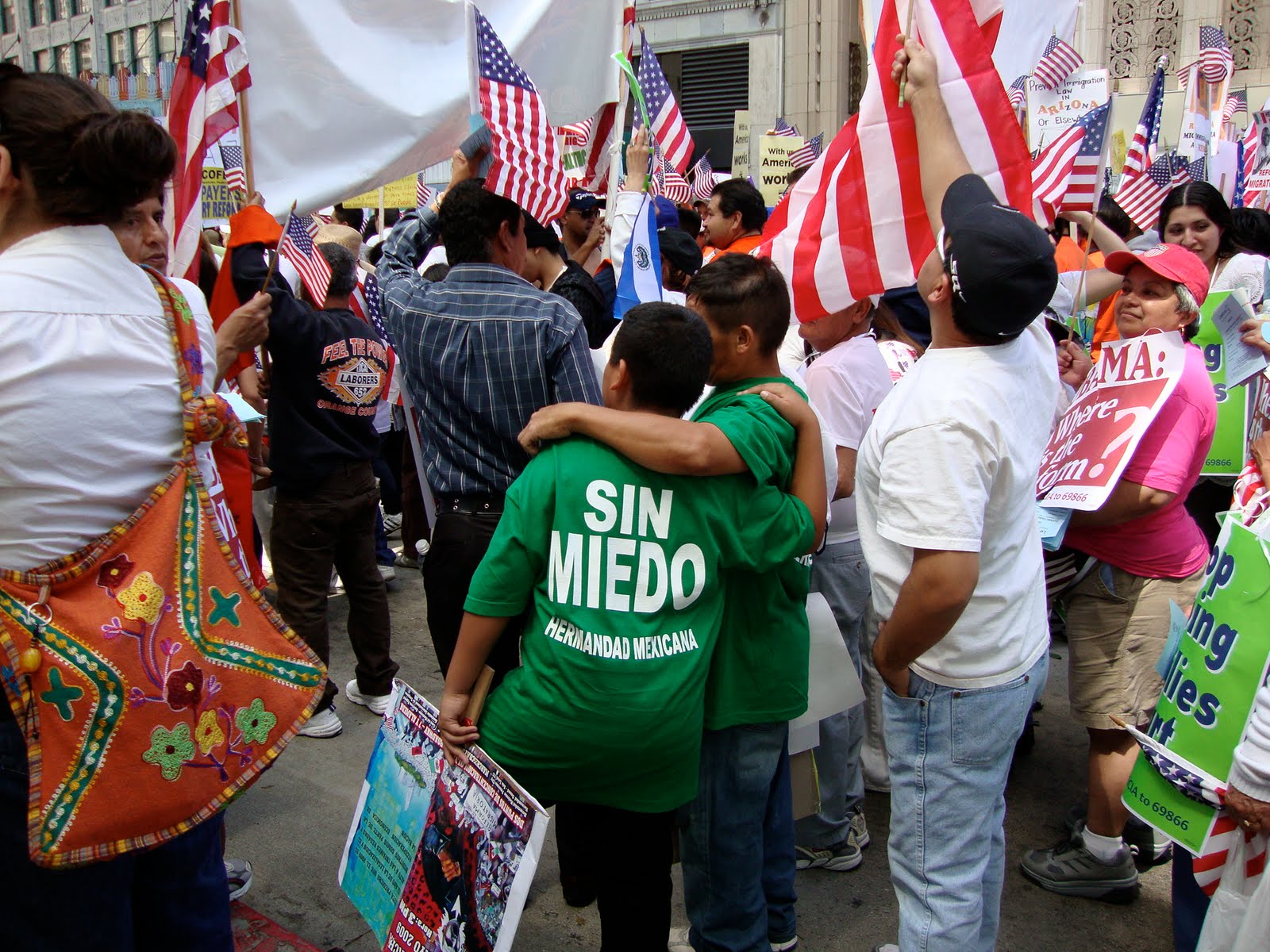
Sin Miedo: A Poem for the May Day Marchers

Walking around the May Day march on Saturday, I saw people dispersed through the crowds wearing true green shirts that said "Indocumentado" (undocumented) on the front, and "Sin Miedo" (without fear) on the back. This father and son were two people wearing these shirts. I was very touched by their courage.

Sin Miedo

He clutches his son,
whole arm tight around shoulders.
They move, side pinned to side,
like a three-legged race,
but these indocumentado do not run.
They walk slow, with purpose.
Father has brought his boy
onto the street, into the den.
Among thousands, they are exposed
to marchers, signs, helicopters
flying over head. Looking
to the sky they appear stacked,
helicopter over helicopter,
over high-rise, over crowds,
over concrete. Red and white
stripes flutter like a satin prison.
He brings his boy in tighter.
Father and son, protector
and protected. But windows
are watching, and people move
in every direction.
They are vulnerable to the whims
of a mob. To brick and Billy clubs,
fire hoses and dogs, rope and hate.
This is what the father considers
as he folds his son under his arm,
and they continue to march.

Monday, May 3, 2010

Shifra Goldman and Poetic Arte!


Saturday night I attended an event of Latino American art, poetry, and academia in celebration of one great artistic mind, Shifra Goldman. If you don’t recognize her name, don’t worry, I didn’t at first either, but I assure you, you have felt her influence. A Jewish American academic, who came from a Yiddish and English bilingual family, she is attributed with being one of the first to call for the conservation of Siquiero’s whitewashed Olvera Street mural, “Tropical America,” when most people forgot it existed. Her critical analysis and books, Dimensions of the Americas, Contemporary Mexican Painting in a Time of Change, had major influence in the European and American art worlds of the 70s and 80s when many believed nothing of significance could be birthed in Latin America, and generally made such names as Rivera, Siquieros, and Orozco world-known.

All this I knew about Shifra, the writer and Latino art champion, before I walked into Avenue 50 Studio on Saturday night, but what I gained by being apart of this celebration was so much more. We began with an acoustic guitar performance by her son, Eric Garcia. After playing two songs, he invited in his preteen son to accompany him on violin, and instantly the crowd was uplifted. The shaggy haired twelve year-old talent was nothing less than charming. Next was film director and writer, Jesus Trevino, who read from his memoir, Eyewitness. He shared a section about Shifra and his time with her, and her influence. As he read it was clear that many in the room know her personally. He spoke of her work with “Tropical America," her philosophy on politics and art (they cannot be separated), and it was like I could hear the audience smiling. The next performer, a poet, Ramon Garcia, was also fortunate enough to know her personally. She had taken him at a time when he was new to Los Angeles. He appeared young, and I wondered how exactly they met. How was he so lucky to have dinners with her at a bad French restaurant in Echo Park? “Taix” he shared with the room, and many laughed. Bad food, but good discussions, a majority of the 60-70 people now crowding in the tiny art studio agreed. I realized that I was only a visitor; I have never met Shifra, but I now wish I could have.

Other poets, Gloria Enedina Alvarez, Adolfo Guzman-Lopez, and George Kalmar, shared poetry and memories, as well as members in the audience, and every story told was like it’s own special gem. Artists, poets, friends, a son, all were touched by her in some significant way. And it seems if you had come to know her, you were certainly influenced by her critical and caring mind. She was a mentor to artists, and other lost children of Los Angeles, and I began to wish I was a little older, a little more lost, a little more hungry and that this surrogate mother could be mine too. I imagined sitting with her in Taix drinking a dirty martini and listening to her speak about art and revolution. I wondered what heated discussion we would have, and how she would generally “school” me as I make notes in my mind. If only.

She is bedridden now, and in the final stages of Alzheimer. Her son shared that he visits with her daily, and before coming to this event he sat with her. He recorded a minute long video of Shifra knotted in her bed, her brilliant mind somewhere locked in the darkness of the past. He carried her into the event on his white Apple laptop, and it was then I remembered Frida Kahlo.


Or I should confess, the movie Frida (Shifra may not have approved since it seems she didn’t care for Hollywood). I remembered the final scene, where Frida, one leg amputated and very ill, lays in bed on the opening night of her exhibit. I remembered the doctor’s order, and how friends carry her, heavy wood-carved bed and all, to the event to celebrate, to see the culmination of her work.

In some way Shifra was there, and we celebrated with her.

UPDATE: Sadly, Shifra Goldman died from complications to Alzheimer at 85 on September 11, 2011. For more on Shifra's life and legacy, you can read her obituary at L.A. Times here or this piece by Adolfo Guzman-Lopez at KCET. She will be missed.

Saturday, May 1, 2010

Images from May Day 2010, Downtown Los Angeles

I arrived in Dowtown around 10:30 am, and joined the march at 9th and Broadway. Walking over to Broadway, I past two women and a young girl. It is possible they were mother, daughter, and granddaughter. They were armored with white shirts and U.S. flags, and like me, they were rushing to get to the march. Hearing them exchange Spanish words, seeing the generations, I fought back tears. Just yesterday I read how Arizona has banned ethnic studies classes and teachers with accents teaching English, and I realize I am not marching or fighting for me, but for them. From 9th all the way up to city hall and Villaraigosa's white doves, commissioned with message of change for the White House, I allowed the power of the people to sweep me up.