I'm excited to share that Writer's at Work has chosen my poem, Ghazal of the Traffic, for their Poem of the Month series. It's great to have one of my "My L.A." poems finally find a home. You can check it out here.
From Ghazal of the Traffic
On a corner a child sells ripe mangos, yellow and green.
She looks familiar, but I have traveled too far in the city.
A hipster girl draped in vintage wails down Hollywood Blvd.
Countless are the broken dreams and scars in the city.
Radio gossip: coke-filled-photos, anorexia, Anna Nicole.
We keep our famous in air-punched-holed jars in the city.
In other news, this past Wednesday, May 11th, marked my grandmother's 90th birthday. That's right, 90! We had a mass to celebrate this past weekend, much like the one we had last year that I wrote about in this post. To commemorate the day, I wrote a little poem about my grandmother. It is a bit of a love letter to my grandmother and to all my cousins. I feel lucky to have had 3 brothers and 15 cousins to grow up with. Like I tell my cousins, Erika and Gloria, at every family wedding (after a couple of rounds of tequila), "I'd kill for you!" Of course, actual blood shed is highly unlikely, but there is little I wouldn't do for my family. I think it also fits into the "My L.A." poems because when I think of L.A., I often think back on weekends spent at my grandmother's home in Boyle Heights.
On the Front Steps
We ate pink and blue ice cream
shaped like feet and rockets
bought from rusty trucks
singing down Fairmont. We gossiped
and giggled into cousins’ ears,
sugary colors dripping onto the
red concrete below us. We watched
the boys play football in the street,
and our grandfather manicure his lawn.
We inhaled the fragrances of orange,
guava, rose, fern, and every other plant
that grew green and full around us.
We grew much the same way
over years, maturing like plants
around her as she nourished us
with tacos de crema, bowls of conflais,
huevos con weenies smothered
in katchun katchun. She tended
to our insatiable bellies with pieces
of chocolate and cookie, and fueled us
with spoons of frijoles from a pot
that never emptied, and like magic
she nursed her little plants
from a tiny kitchen, and we sprouted
into wild creatures too big for front steps.
Knowing we could never be potted
and still, she sent us off with a kiss
and a prayer, “Que Dios lo bendiga,”
and stood at the top of the steps—
yellow light of the house framing her
small body like a saint—to wave us goodbye,
our bellies full, our hearts and minds strong.
Showing posts with label Los Angeles. Show all posts
Monday, May 16, 2011
Saturday, April 23, 2011
A Poem by William Archila
Latest News
At work, no one has seen him or his taxi.
Newspapers read, "Juan Márquez Missing:
Any sighting, please contact family."
A few months ago, police led a trail
to graves: some broken bones,
the kind you find in times of war.
In Nicaragua, they remember him,
poet so blue and modern like Dario,
almost a song of swans about to break.
Honduras spoke of him naked, hairless,
barefoot, tobacco skin without toenails
or ears, a man of ants and stray dogs.
Two weeks ago, a boy found a body
dark as eggplant. His wife, worn and rumpled,
could not recognize the blown-out face.
My mother thinks he's deep in the ground,
sleeping with torn clothes, thick,
dank roots spreading over his limbs.
The rumor goes at night in smoky bars
he met Jesus of Nazareth, a red lightbulb
flickering on and off in the corner.
Today I heard he's a bus driver
in L.A., circling long avenues,
parks, the same hotel signs, traffic
lights, the rain that falls at night.
Around ten, a rumor goes he gets lost
in a downtown dive, drinks his shot of gin.
Don Chamba, a shoe shiner from Santa Anita,
gave me the final word the other day.
"To me," he says, "those stories don't mean shit.
By now, after all those small deaths,
he has to be a soiled shoe, a worn-out tire,
aflame, smoking by an empty highway."

This poem is published in William Archila's debut collection: The Art of Exile (Bilingual Press, 2009).
William Archila was born in Santa Ana, El Salvador, in 1968. When he was only twelve, he and his family immigrated to the United States to escape the civil war that was tearing his country apart. He eventually becaem an English teacher and earned his MFA in poetry from University of Oregon. His poems have appeared in Agni, Blue Mesa Review, Crab Orchard Revewi, The Georgia Review, and The Los Angeles Review. He lives in Los Angeles with his wife.
The Art of Exile is the recent winner of the Emerging Writer Fellowship Award from the Writer’s Center and the International Latino Book Award. The Art of Exile was also featured in “First Things First: The Fifth Annual Debut Poets Roundup” — the Jan/Feb 2010 issue of Poets & Writers.
For more on this collection and Salvadorean literature check out Adolfo Guzman-Lopez's KPCC article, "Salvadoran American's Poetry Makes Amends for Silence Over Civil War."
At work, no one has seen him or his taxi.
Newspapers read, "Juan Márquez Missing:
Any sighting, please contact family."
A few months ago, police led a trail
to graves: some broken bones,
the kind you find in times of war.
In Nicaragua, they remember him,
poet so blue and modern like Dario,
almost a song of swans about to break.
Honduras spoke of him naked, hairless,
barefoot, tobacco skin without toenails
or ears, a man of ants and stray dogs.
Two weeks ago, a boy found a body
dark as eggplant. His wife, worn and rumpled,
could not recognize the blown-out face.
My mother thinks he's deep in the ground,
sleeping with torn clothes, thick,
dank roots spreading over his limbs.
The rumor goes at night in smoky bars
he met Jesus of Nazareth, a red lightbulb
flickering on and off in the corner.
Today I heard he's a bus driver
in L.A., circling long avenues,
parks, the same hotel signs, traffic
lights, the rain that falls at night.
Around ten, a rumor goes he gets lost
in a downtown dive, drinks his shot of gin.
Don Chamba, a shoe shiner from Santa Anita,
gave me the final word the other day.
"To me," he says, "those stories don't mean shit.
By now, after all those small deaths,
he has to be a soiled shoe, a worn-out tire,
aflame, smoking by an empty highway."

This poem is published in William Archila's debut collection: The Art of Exile (Bilingual Press, 2009).
William Archila was born in Santa Ana, El Salvador, in 1968. When he was only twelve, he and his family immigrated to the United States to escape the civil war that was tearing his country apart. He eventually becaem an English teacher and earned his MFA in poetry from University of Oregon. His poems have appeared in Agni, Blue Mesa Review, Crab Orchard Revewi, The Georgia Review, and The Los Angeles Review. He lives in Los Angeles with his wife.The Art of Exile is the recent winner of the Emerging Writer Fellowship Award from the Writer’s Center and the International Latino Book Award. The Art of Exile was also featured in “First Things First: The Fifth Annual Debut Poets Roundup” — the Jan/Feb 2010 issue of Poets & Writers.
For more on this collection and Salvadorean literature check out Adolfo Guzman-Lopez's KPCC article, "Salvadoran American's Poetry Makes Amends for Silence Over Civil War."
Sunday, February 27, 2011
Banksy in L.A.: The Academy Awards Edition
I'm sitting in my living room at this moment watching, like many others around the country, the Academy Awards. One person in town for the event is world renowned street artist Banksy. How do we know he is in L.A.? Because he left his tracks on the eastside of town.
The blogger, LA Eastside found this Banksy original on the corner of 1st and Soto St, in a part of town known as East L.A. or Boyle Heights. From those not from Los Angeles, this area sits in the shadows east of Downtown L.A. and is home to many Latino immigrants from Mexico, Central and South America, cultural centers like Josefina Lopez's Casa 0101 and Corazon del Pueblo, as well as long lasting Mexican-American families like my own. My grandparents moved into a home only blocks from this corner 50 years ago when they first came to the U.S., and my grandmother continues to live in that same home today. This is what I often call, my L.A. As young and beautiful people from all over the country continue to flock to Los Angeles every year, heads filled with dreams of being high, hip, and on TV, there is another L.A., my L.A. that is rich with culture and a long history.
Banksy is currently in L.A. for an Academy nomination for his documentary, Exit Through the Gift Shop. It's good to know that true artists will always work to bring light to a greater struggle. Banksy may be in Los Angeles to participate in the Hollywood dream, but he is also aware of its reality.
And the reality of street art is nothing lasts, as shown in this post by Melrose & Fairfax blog.
One or two days after going up, Banksy's latest stencil was tagged by a graffiti artist before the whole thing was cut out of the wall, probably to be auctioned for hundreds of thousands of dollars. Some seem outraged by the vandalism of Banksy's piece and the cutting of the wall, but I'm sure Banksy is more than happy with this one piece's journey. It is what Exit Through the Gift Shop is about, after all. Banksy isn't working under some naive belief that his artwork will be left alone. But I like to believe that the owners of that building, those who cut the wall, are a hardworking, immigrant family who could use the extra money to send their kids to school. That would make for a nice Hollywood fantasy. Maybe Selena Gomez will play the smart, but sassy daughter who can finally head to Stanford after struggling all through her youth selling oranges on the street in the Movie. Take that Christian Bale.
The blogger, LA Eastside found this Banksy original on the corner of 1st and Soto St, in a part of town known as East L.A. or Boyle Heights. From those not from Los Angeles, this area sits in the shadows east of Downtown L.A. and is home to many Latino immigrants from Mexico, Central and South America, cultural centers like Josefina Lopez's Casa 0101 and Corazon del Pueblo, as well as long lasting Mexican-American families like my own. My grandparents moved into a home only blocks from this corner 50 years ago when they first came to the U.S., and my grandmother continues to live in that same home today. This is what I often call, my L.A. As young and beautiful people from all over the country continue to flock to Los Angeles every year, heads filled with dreams of being high, hip, and on TV, there is another L.A., my L.A. that is rich with culture and a long history.
Banksy is currently in L.A. for an Academy nomination for his documentary, Exit Through the Gift Shop. It's good to know that true artists will always work to bring light to a greater struggle. Banksy may be in Los Angeles to participate in the Hollywood dream, but he is also aware of its reality.
And the reality of street art is nothing lasts, as shown in this post by Melrose & Fairfax blog.
One or two days after going up, Banksy's latest stencil was tagged by a graffiti artist before the whole thing was cut out of the wall, probably to be auctioned for hundreds of thousands of dollars. Some seem outraged by the vandalism of Banksy's piece and the cutting of the wall, but I'm sure Banksy is more than happy with this one piece's journey. It is what Exit Through the Gift Shop is about, after all. Banksy isn't working under some naive belief that his artwork will be left alone. But I like to believe that the owners of that building, those who cut the wall, are a hardworking, immigrant family who could use the extra money to send their kids to school. That would make for a nice Hollywood fantasy. Maybe Selena Gomez will play the smart, but sassy daughter who can finally head to Stanford after struggling all through her youth selling oranges on the street in the Movie. Take that Christian Bale.
Tuesday, May 4, 2010
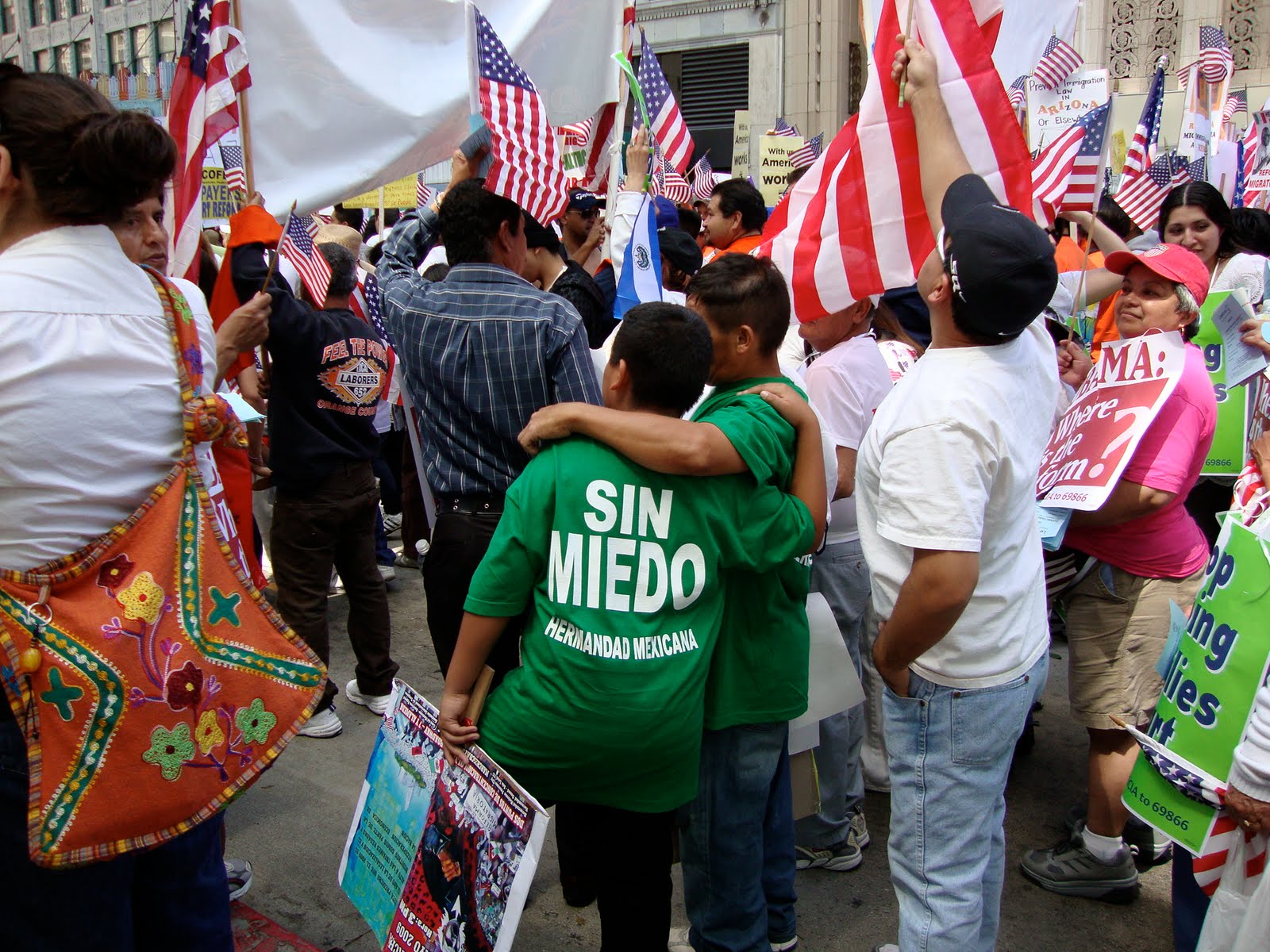
Sin Miedo: A Poem for the May Day Marchers
Sin Miedo
He clutches his son,
whole arm tight around shoulders.
They move, side pinned to side,
like a three-legged race,
but these indocumentado do not run.
They walk slow, with purpose.
Father has brought his boy
onto the street, into the den.
Among thousands, they are exposed
to marchers, signs, helicopters
flying over head. Looking
to the sky they appear stacked,
helicopter over helicopter,
over high-rise, over crowds,
over concrete. Red and white
stripes flutter like a satin prison.
He brings his boy in tighter.
Father and son, protector
and protected. But windows
are watching, and people move
in every direction.
They are vulnerable to the whims
of a mob. To brick and Billy clubs,
fire hoses and dogs, rope and hate.
This is what the father considers
as he folds his son under his arm,
and they continue to march.
Monday, May 3, 2010
Shifra Goldman and Poetic Arte!

Saturday night I attended an event of Latino American art, poetry, and academia in celebration of one great artistic mind, Shifra Goldman. If you don’t recognize her name, don’t worry, I didn’t at first either, but I assure you, you have felt her influence. A Jewish American academic, who came from a Yiddish and English bilingual family, she is attributed with being one of the first to call for the conservation of Siquiero’s whitewashed Olvera Street mural, “Tropical America,” when most people forgot it existed. Her critical analysis and books, Dimensions of the Americas, Contemporary Mexican Painting in a Time of Change, had major influence in the European and American art worlds of the 70s and 80s when many believed nothing of significance could be birthed in Latin America, and generally made such names as Rivera, Siquieros, and Orozco world-known.
All this I knew about Shifra, the writer and Latino art champion, before I walked into Avenue 50 Studio on Saturday night, but what I gained by being apart of this celebration was so much more. We began with an acoustic guitar performance by her son, Eric Garcia. After playing two songs, he invited in his preteen son to accompany him on violin, and instantly the crowd was uplifted. The shaggy haired twelve year-old talent was nothing less than charming. Next was film director and writer, Jesus Trevino, who read from his memoir, Eyewitness. He shared a section about Shifra and his time with her, and her influence. As he read it was clear that many in the room know her personally. He spoke of her work with “Tropical America," her philosophy on politics and art (they cannot be separated), and it was like I could hear the audience smiling. The next performer, a poet, Ramon Garcia, was also fortunate enough to know her personally. She had taken him at a time when he was new to Los Angeles. He appeared young, and I wondered how exactly they met. How was he so lucky to have dinners with her at a bad French restaurant in Echo Park? “Taix” he shared with the room, and many laughed. Bad food, but good discussions, a majority of the 60-70 people now crowding in the tiny art studio agreed. I realized that I was only a visitor; I have never met Shifra, but I now wish I could have.
Other poets, Gloria Enedina Alvarez, Adolfo Guzman-Lopez, and George Kalmar, shared poetry and memories, as well as members in the audience, and every story told was like it’s own special gem. Artists, poets, friends, a son, all were touched by her in some significant way. And it seems if you had come to know her, you were certainly influenced by her critical and caring mind. She was a mentor to artists, and other lost children of Los Angeles, and I began to wish I was a little older, a little more lost, a little more hungry and that this surrogate mother could be mine too. I imagined sitting with her in Taix drinking a dirty martini and listening to her speak about art and revolution. I wondered what heated discussion we would have, and how she would generally “school” me as I make notes in my mind. If only.
She is bedridden now, and in the final stages of Alzheimer. Her son shared that he visits with her daily, and before coming to this event he sat with her. He recorded a minute long video of Shifra knotted in her bed, her brilliant mind somewhere locked in the darkness of the past. He carried her into the event on his white Apple laptop, and it was then I remembered Frida Kahlo.

Or I should confess, the movie Frida (Shifra may not have approved since it seems she didn’t care for Hollywood). I remembered the final scene, where Frida, one leg amputated and very ill, lays in bed on the opening night of her exhibit. I remembered the doctor’s order, and how friends carry her, heavy wood-carved bed and all, to the event to celebrate, to see the culmination of her work.
In some way Shifra was there, and we celebrated with her.
UPDATE: Sadly, Shifra Goldman died from complications to Alzheimer at 85 on September 11, 2011. For more on Shifra's life and legacy, you can read her obituary at L.A. Times here or this piece by Adolfo Guzman-Lopez at KCET. She will be missed.
Saturday, May 1, 2010
Images from May Day 2010, Downtown Los Angeles
I arrived in Dowtown around 10:30 am, and joined the march at 9th and Broadway. Walking over to Broadway, I past two women and a young girl. It is possible they were mother, daughter, and granddaughter. They were armored with white shirts and U.S. flags, and like me, they were rushing to get to the march. Hearing them exchange Spanish words, seeing the generations, I fought back tears. Just yesterday I read how Arizona has banned ethnic studies classes and teachers with accents teaching English, and I realize I am not marching or fighting for me, but for them. From 9th all the way up to city hall and Villaraigosa's white doves, commissioned with message of change for the White House, I allowed the power of the people to sweep me up.


Subscribe to:
Posts (Atom)